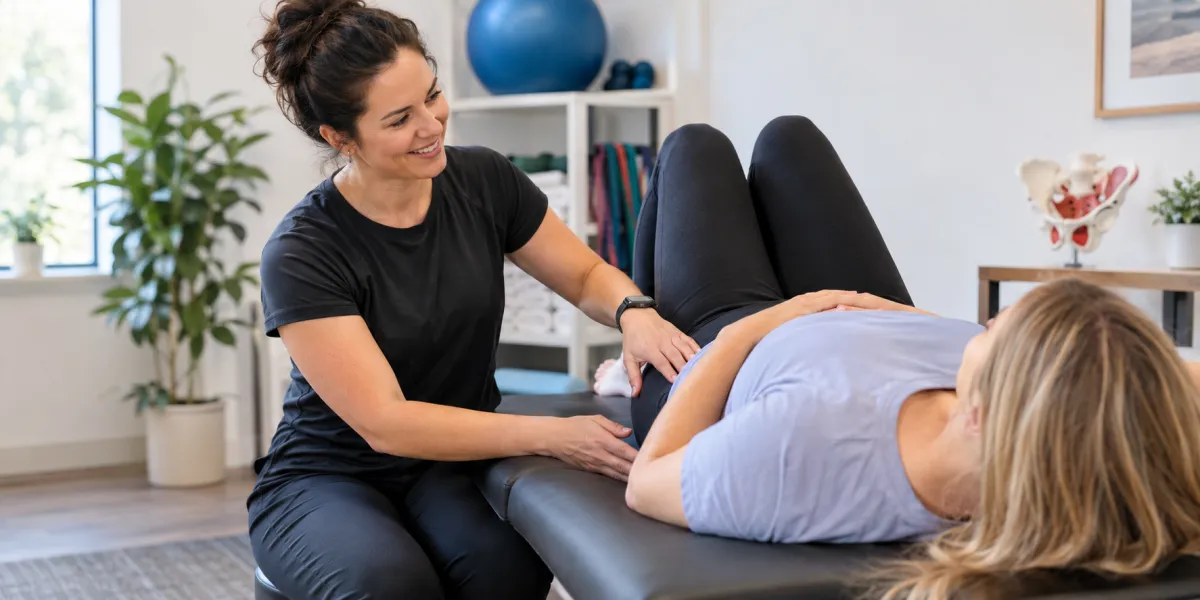
Pelvic Floor Therapy Looks Different for Every Patient and Every Therapist
Pelvic Floor Therapy Looks Different for Every Patient and Every Therapist
If you’ve ever wondered what actually happens in pelvic floor therapy, the answer is: it depends.
It depends on your symptoms, your goals, your comfort level, your medical history, and even which therapist you see.
At Practically Perfect Physical Therapy, we believe that’s a good thing.
Pelvic floor concerns are incredibly personal. Someone coming to us because they leak when they sneeze may need a completely different approach than someone experiencing pelvic pain, constipation, prolapse, pain with intimacy, or postpartum weakness.
That’s why we don’t believe in one-size-fits-all pelvic floor therapy.
Pelvic Floor Therapy Is More Than Kegels
One of the biggest misconceptions about pelvic floor therapy is that everyone who walks through our doors will be told to do Kegels.
Sometimes strengthening is appropriate but sometimes it absolutely isn’t.
Your pelvic floor muscles need to be able to contract, relax, coordinate, and respond appropriately to what the rest of your body is doing.
Treatment may include things like:
Breathing and pressure management
Core and hip strengthening
Pelvic floor coordination
Relaxation and down-training
Mobility exercises
Postural or movement changes
External manual therapy
Internal assessment or treatment when appropriate and consented to
Education about bladder, bowel, sexual, or exercise habits
A personalized home program
The goal isn't simply to make your pelvic floor "stronger." We want it to work better for your life.
Our Therapists Bring Different Strengths to Pelvic Floor Care
Another thing that makes Practically Perfect Physical Therapy a little different is that our providers don't all practice pelvic floor therapy in exactly the same way.
Our therapists have different training, clinical experience, and areas of interest. That allows us to help match you with a provider whose skills fit what you're experiencing.
Dr. Mora treats pelvic floor concerns alongside orthopedics and whole-body movement. This can be especially helpful when pelvic symptoms overlap with hip, back, abdominal, or musculoskeletal concerns.
Dr. Nicole combines pelvic floor therapy with her experience in pediatrics, pregnancy, postpartum care, and complex pelvic health concerns.
Dr. Becky can address pelvic floor concerns through external assessment and treatment. She can work with issues such as leaking, prolapse symptoms, pain, weakness, and movement dysfunction using exercise, education, strengthening, coordination, and external manual therapy.
The important part?
You don't have to figure out which approach you need before you come in.
Our team can help determine which provider is the best fit for your symptoms, goals, and comfort level.
Does Pelvic Floor Therapy Require an Internal Exam?
No.
An internal pelvic floor assessment can provide useful information for some patients, but it is not the only way to evaluate or treat pelvic floor dysfunction.
There is a lot we can learn by looking at breathing, movement, strength, coordination, posture, abdominal function, hips, spine, symptoms, and daily habits.
If an internal assessment may be beneficial, your therapist will explain why, what it involves, and what information it could provide.
You are always in control of your care.
You can ask questions. You can decline. You can change your mind. And your treatment plan can be adjusted accordingly.
The Same Symptom Doesn't Always Have the Same Solution
Two people can walk into our office with the exact same complaint and leave with completely different treatment plans.
Take leaking, for example.
One person may need more pelvic floor strength.
Another may already have a pelvic floor that is working too hard and needs to learn how to relax.
Someone else may have plenty of pelvic floor strength but struggle with coordination, breathing, pressure management, or timing during exercise.
That's why simply Googling "exercises for bladder leaking" doesn't always solve the problem.
We want to understand why the symptom is happening for you.
Pelvic Floor Therapy Is About More Than Your Pelvic Floor
Your pelvic floor doesn't exist in isolation.
It works with your diaphragm, abdominal muscles, hips, spine, nervous system, and the rest of your body.
That's why an appointment at Practically Perfect Physical Therapy may look different than you expected.
We might talk about how you breathe when you lift your child.
We might look at your squat.
We might discuss how often you go to the bathroom.
We might work on hip strength.
We might address scar mobility.
We might talk about constipation.
We might change how you're performing an exercise at the gym.
And yes, sometimes we may specifically assess or treat the pelvic floor muscles.
It's all pelvic floor therapy.
Finding the Right Fit Matters
Pelvic floor therapy can address very personal concerns. Feeling comfortable with your therapist matters.
At Practically Perfect Physical Therapy, our goal isn't to put every patient through the same protocol. It's to meet you where you are and create a treatment plan that makes sense for your body, your symptoms, your goals, and your comfort level.
Whether you're dealing with leaking, urgency, constipation, pelvic pain, prolapse symptoms, pregnancy or postpartum changes, painful intimacy, weakness, or simply feeling like something isn't quite right, you don't have to decide which type of pelvic floor treatment you need before making an appointment.
That's our job.
We'll listen to what's going on, help you understand your options, and connect you with the provider and treatment approach that make the most sense for you.
Ready to Talk About Your Pelvic Health?
Practically Perfect Physical Therapy offers individualized, one-on-one care in private treatment rooms in Galloway, New Jersey.
📍 311 S. New York Road, Suite 1A
Galloway, NJ 08205
📞 (609) 300-3963
🌐 www.practicallyperfectpt.com
You don't need to know exactly what's wrong before you call.
Just tell us what's bothering you. We'll help you figure out the next step.
