The Birth Story I Never Expected to Tell
The Birth Story I Never Expected to Tell
By Dr. Mora Pluchino, PT, DPT — Owner of Practically Perfect Physical Therapy
It's been almost seven months since I welcomed my second daughter, Josie, into the world. Seven months since I became a mom of two. And seven months since my life took a turn that I never could have imagined.
As a pelvic floor therapist, I've spent years helping people prepare for birth, recover postpartum, and navigate the unexpected challenges that come with parenthood. I thought I had a pretty good understanding of what postpartum recovery could look like.
Apparently, life had other plans.
This is my birth story. It's not the one I expected to tell, but it's ours.
Getting to Josie
Our journey to baby number two wasn't exactly straightforward.
After six months of trying to conceive, I made an appointment with a reproductive endocrinologist. With my history of thyroid cancer and my advanced maternal age (a phrase every woman just LOVES hearing), I knew it was time to ask for some help. They said my progesterone was low and as soon as we started supplementing, I was pregnant.
When I finally became pregnant, I was thrilled. We were going to welcome another baby into our family, and Nina was going to be a big sister! Pregnancy itself, however, was not my favorite experience.
With Nina, I vomited daily for the first five months. With Josie, I didn't vomit nearly as much, but I experienced almost constant nausea throughout the pregnancy. Apparently, my body likes to make sure I really appreciate the end result. My progesterone was low for the first 24 weeks. Just when I thought we were on an upswing, I was diagnosed with gestational diabetes at week 28 and had to do all the monitoring and changes that goes along with that.
When it came to delivery, I had already made my decision. My first birth involved a failed induction, 38 hours of labor, and ultimately a cesarean delivery. This time, I chose a planned C-section. As a pelvic floor therapist, I believe strongly in educating patients about their options and helping them make informed decisions about their bodies. For me, a planned cesarean felt like the right choice.
April 1, 2026: The Best April Fools' Day Ever
The day before my scheduled C-section, I actually started having contractions. We headed to the hospital on March 31 for monitoring, where we learned I was in early labor but hadn't started dilating. So, back home we went. The next morning, we woke up early, headed to the hospital, and went through all the usual preoperative preparations.
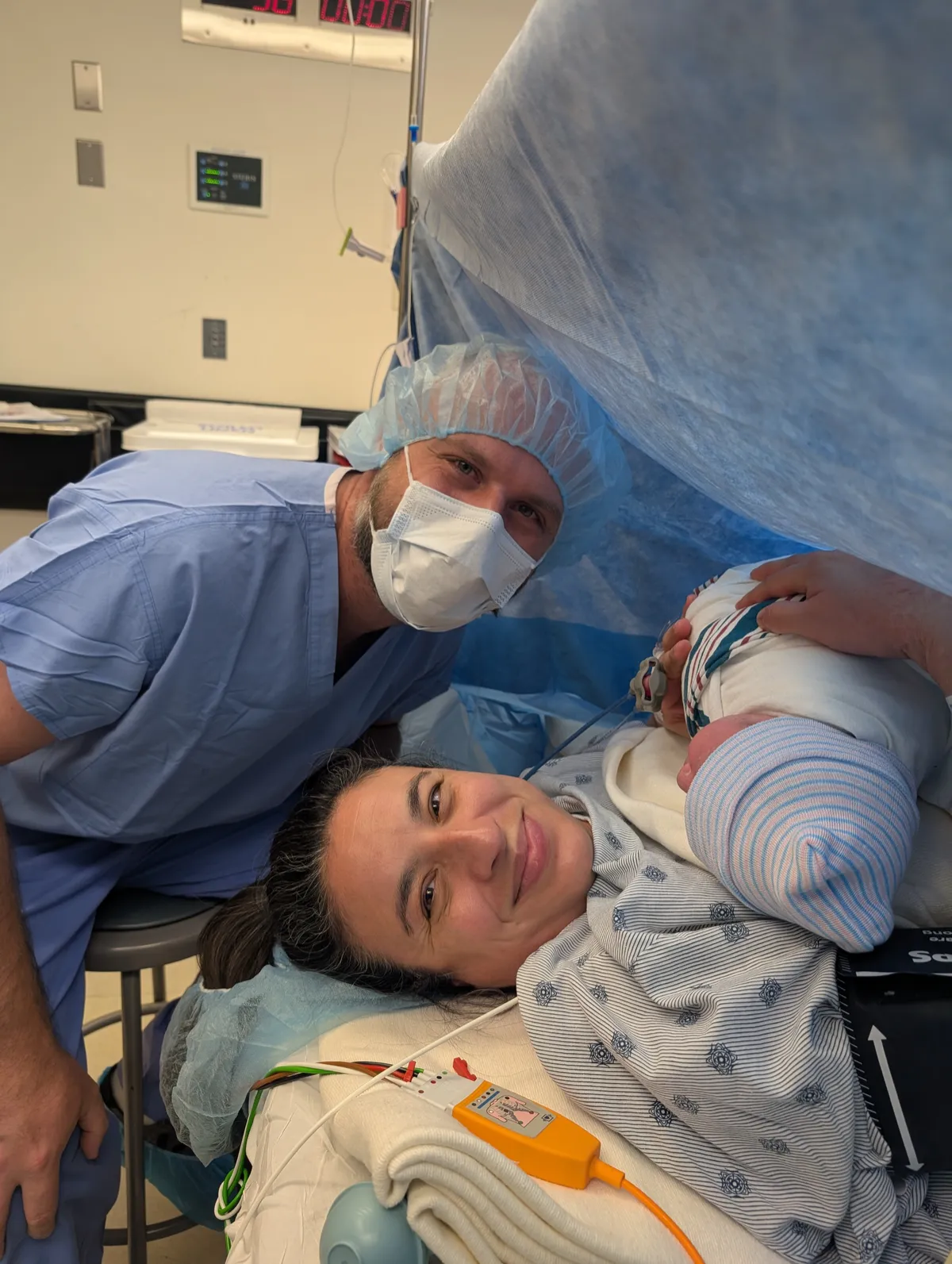
After my first birth experience, I wasn't entirely sure how I would feel going into another operating room. When the anesthesiologist administered my spinal, I unexpectedly started crying. I couldn't really explain why. Looking back, I think it may have been my body releasing some of the trauma from my first delivery. But after that, everything felt peaceful. The room was relaxed. The procedure went smoothly. Jeff watched our daughter enter the world, and then we got to hold her and snuggle her while the surgical team finished closing.
My first thought when I saw Josie? LOOK AT ALL THAT HAIR!
My second thought was pure gratitude. She was here. She was healthy. She was safe. And I was holding my beautiful baby girl. For a baby born on April Fools' Day, there were no surprises, tricks, or pranks. Just a beautiful, uncomplicated birth. Exactly what I had hoped for.
Six Perfect Days
Our first six days with Josie were everything I had imagined. We worked on breastfeeding. We figured out sleeping (or, more accurately, not sleeping). We snuggled. We bonded. We introduced Josie to our family and settled into life with two daughters. I was also navigating the normal challenges of recovering from a cesarean. And yes, I was absolutely using all the tricks I teach my patients!
I was moving like a mermaid to get in and out of bed, wearing compression, practicing breathing exercises, incorporating gentle movement, and managing the ever-so-glamorous world of postoperative constipation. It felt good to practice what I preach. I was sore, tired, and adjusting to newborn life, but I was happy. We had our baby. We were home. Everything was going well.
The Day Everything Changed
On April 7, Josie was six days old.
We had a virtual lactation appointment that morning and were getting ready to visit Jeff's elderly aunt before heading to the pediatrician for a bilirubin check. It was supposed to be a normal day. Instead, I began experiencing neurological symptoms. As a physical therapist, I knew enough to recognize that something was seriously wrong. And while I was frightened about what was happening to my body, one of my most overwhelming thoughts was that I was going to have to leave my baby. My six-day-old baby.
I had just brought her home. We were still learning each other. We were breastfeeding, bonding, and figuring out our new routine. And suddenly, I was facing the possibility of being separated from her.
I remember asking Jeff and my mom for help. I remember the ambulance team showing up and trouble shooting. The time where we left my house until I “woke up” on May 9th is a black hole.
When I did “wake up” I learned I had suffered a hemorrhagic stroke. What followed was a medical journey involving emergency treatment, critical care, and extensive rehabilitation. There are details of that experience that I remember and others that I don't. But what I want to focus on here isn't everything that happened medically. It's what happened to us as a family, and how Josie remained at the center of my recovery.
Learning to Be a Mom Again
One of the most extraordinary parts of my rehabilitation experience was that my care team recognized something incredibly important. I wasn't just a stroke patient, I was a brand-new mother. Being able to bond with Josie wasn't simply a nice bonus during recovery. It was an essential part of my life and something I desperately wanted to regain. My rehabilitation teams incorporated caring for Josie into my treatment plan.
Occupational therapists helped me relearn how to safely hold, feed, and care for my baby. We practiced the activities that most new parents take for granted. For someone who had spent her career helping patients regain independence, suddenly needing help with these basic activities was humbling and scary.
Sometimes, knowing too much about the human body isn't necessarily comforting. As a physical therapist, I understood the potential complications of a stroke and the uncertainty surrounding neurological recovery. I knew what could go wrong but I also understood neuroplasticity, rehabilitation, repetition, and the importance of meaningful goals. I had one very meaningful goal waiting for me. I wanted to be able to take care of my girls.
From Therapist to Patient
I've spent my career on one side of the treatment table. This experience put me firmly on the other. My recovery involved physical therapy, occupational therapy, speech therapy, and mental health therapy. I progressed through inpatient rehabilitation, home care, and outpatient services.
There were enormous milestones. Learning to walk independently again. Regaining the ability to manage everyday activities. Being able to drive during the daytime. Gradually reclaiming my role as an active, independent mother. Some progress was obvious. Other progress was so small that it was difficult to recognize in the moment.
Today, I'm continuing my recovery with physical therapy, personal training, and chair yoga. It's not fast. It's not linear. And it certainly isn't how I expected to spend the first seven months of my daughter's life. But I'm still making progress. One foot in front of the other. Literally and figuratively.
Motherhood Looks a Little Different These Days
Before Josie was born, I imagined returning to my usual routine of running Practically Perfect Physical Therapy, treating patients, teaching, managing our household, and raising two girls. Instead, my life looks very different. I'm working significantly less than I anticipated. Much of my time outside of caring for my daughters is devoted to therapy, exercise, and recovery. And that's okay.
Nina has been incredibly loving and caring throughout this experience. Our family has been through a lot, and we're all participating in therapy to help process everything that happened.
Josie, meanwhile, continues doing what babies do best: growing, learning, and reminding us that life doesn't stop moving forward just because things don't go according to plan. I'm still her mom. I'm still Nina's mom. I'm still a physical therapist. I'm still a business owner. And I'm still me.
One thing I’d love people to understand. I've experienced a significant medical event, and my body is still recovering. But I remain cognitively capable, professionally knowledgeable, and fully invested in my family and my work. I may move differently. I may need more time or support for certain activities. My schedule and priorities have changed. But my abilities, knowledge, and identity should not be underestimated because I've had a stroke.
It Really Does Take a Village
I don't think it's possible to tell this story without acknowledging the incredible people who have carried us through these past several months. My parents have been absolute rockstars. They've stepped in to help manage our household, care for the girls, and keep our family functioning through circumstances none of us could have predicted. Jeff has been a dedicated partner and father, navigating the demands of caring for Josie while supporting our family through an incredibly difficult time.
The team at Practically Perfect Physical Therapy has kept our practice moving forward, continuing to care for our patients and manage the day-to-day operations while I've focused on recovery.
And our community?
You have been incredible.
The messages, encouragement, generosity, and support through our GoFundMe have meant more than I can adequately express. Our family has felt the love, and so has Practically Perfect Physical Therapy.
I am also deeply grateful to the healthcare professionals who cared for me throughout my hospitalization and rehabilitation. They helped me regain independence while recognizing the importance of my role as a mother.
Recovery doesn't happen in isolation. I'm living proof of that.
What Seven Months Have Taught Me
I already considered myself an empathetic healthcare provider. I've always believed in listening to patients, respecting their experiences, and understanding that recovery isn't just about objective measurements. But being the patient has given me a perspective I couldn't have learned from a textbook, continuing education course, or years of clinical practice.
I now understand even more deeply what it means to have your independence disrupted. What it feels like to need help with things you used to do automatically. How exhausting recovery can be. How frustrating it is when your brain knows exactly what you want your body to do, but your body isn't quite ready to cooperate. And how meaningful the smallest victories can become.
I think this experience will make me an even more understanding physical therapist. Not because I wasn't compassionate before, but because I've now experienced another side of healthcare firsthand.
The Birth Story I Never Expected to Tell
When I think back to April 1, I still remember the peaceful operating room, Jeff watching our daughter be born, and the moment I held Josie and saw all that beautiful hair. I remember those six wonderful days at home. And I remember how desperately I wanted to stay with my baby when I realized something was wrong.
I didn't expect my postpartum journey to involve a stroke, intensive rehabilitation, or learning to walk independently again. I didn't expect to spend so much of my daughter's infancy in recovery. But I also didn't expect to experience the incredible support, generosity, and love that our family has received.
If there's one thing I want other mothers to take away from my story, it's this:
Give yourself grace.
Your birth might not go according to plan.
Your postpartum recovery might look different from what you imagined.
Your body might need more time than you want to give it.
And sometimes life throws something at you that no amount of preparation could have prevented.
Set small goals. Celebrate the little victories. Accept help. Allow yourself to feel frustrated, sad, grateful, and hopeful - sometimes all in the same day.
No one knows exactly how their story will unfold.
Almost seven months later, I'm still recovering. I'm still learning. I'm still adjusting to a version of motherhood I never anticipated. But I'm also watching my beautiful girls grow, finding ways to return to the work I love, and continuing to put one foot in front of the other.
And every day, I get to be Josie and Nina’s mom.
Josie being here safe and whole is the part of this birth story I want to hold on to.
For a closer look at Dr. Mora's rehabilitation journey, read Kessler Institute for Rehabilitation's feature on her recovery.
